



European Astrocartography Interview Series 2025–26
Introduction – The Expat Astrologer
“I am South African, and I was born in South Africa. I come from a family of expats.”
“I’ve always been drawn to what makes people move from their home countries.”
South Africa is not simply the location where Meg Knox-Davies was born. In her case, it is the place where relocation begins as lived reality rather than later specialisation. Before astrocartography entered her vocabulary, movement was already embedded in her life through family, migration, and inherited experience.
“When my mom moved to South Africa from Canada, it was during apartheid — a very intense time in South African history. As an outsider coming into a country with a lot of political issues, it was frowned upon. Some of her family weren’t very pleased that she made the decision to live there.”

South Africa appears here not as a neutral backdrop, but as a historically and symbolically complex place of origin. Baigent, Campion and Harvey describe South Africa as “a special case”, noting the country’s divided astrological and political character and the difficulty of reducing it to a single centre or identity (Mundane Astrology: An Introduction to the Astrology of Nations and Groups, Aquarian Press, 1984).
The Maps found Meg
It is from this lived context that astrocartography later emerges, not as an abstract system, but as a way of recognising patterns that were already present.
“When I found out that astrogeography existed, it mapped a lot of things in my own chart and explained why we were drawn to places so different from what we had known.”
The discovery is immediate and personal. Astrocartography does not appear here as a technique imposed from outside. It becomes a framework through which lived experience — her family’s movements, her own relocations, and the deeper patterns behind them — can be understood with clarity and precision.
“And yet, when I look at her chart and the map of South Africa, she has this beautiful line that links perfectly to her chart. There was a reason why she moved there — not just because of my dad or love, but because of energy. And the same applies to me.”
What emerges from Meg’s origin story is a practitioner whose authority begins with lived reality. Her work establishes a clear position: astrocartography is not applied to life from the outside. It reveals patterns that are already present within it.
The relationship between place and the psyche has been recognised within astrocartography since its earliest development.
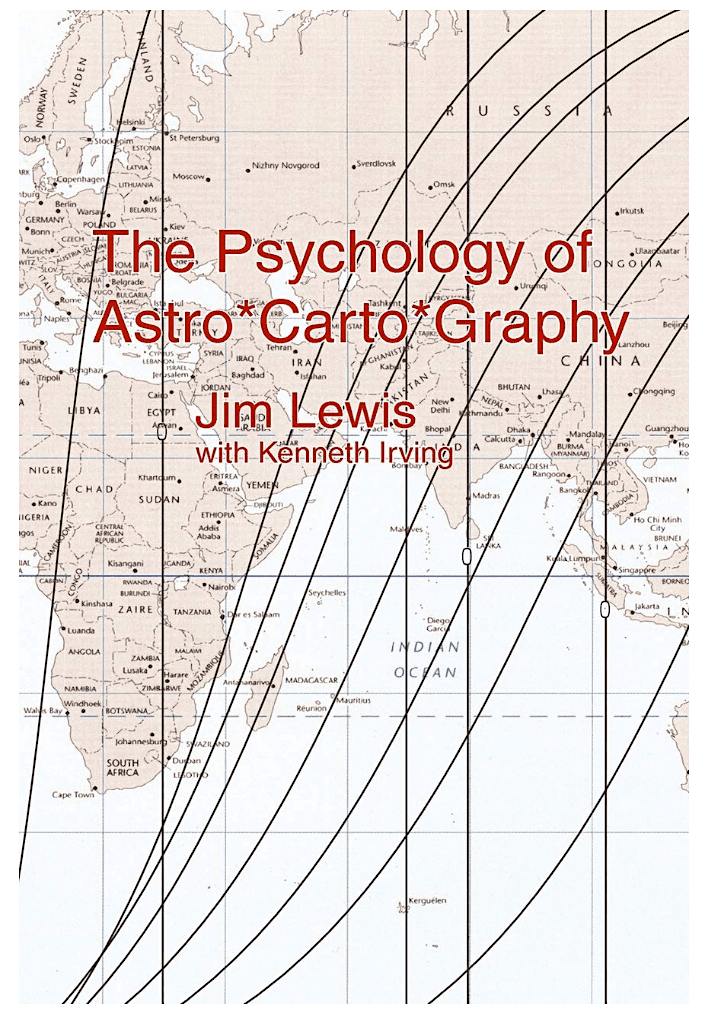
“Geography is very powerfully linked with the psyche. Though we may not be certain of the precise link between firmament and terra firma that brought about the startling events in South Africa, if we have a known date and time of birth , we can in fact plot lines of planetary influence on a map showing which places on earth might relate to the energies of which planets in a given case“.
Quote by Kenneth Irving
The Original Place and the Psychological Imprint of Birth
“I always tell them: Look at the planetary lines in a place — but also look at where you were born, because that energy stays with you.”
This statement defines the central principle of Meg Knox-Davies’ approach. Instead of treating your birthplace like a neutral coordinate, she considers it as an entire environment through which the natal chart is lived. This includes, cultural, familial, economic or political climate of a specific location.
In astrocartographic terms, the original location establishes an experiential baseline. Long before a person begins analysing maps or relocated charts, the angular structure of the birth environment may already have become psychologically normal. It is from this baseline that all subsequent places are perceived, evaluated, and integrated.
“For example, I was born on a Saturn line.”
“Saturn is a big player in my chart.”
“That energy carries with me no matter where I go.”
Here, the principle becomes concrete. The planetary condition present at birth does not remain confined to a location. It becomes part of the individual’s ongoing experience. In Meg’s account, Saturn is not tied to South Africa as a fixed point on the map. It is carried forward as a continuous influence shaping how later environments are encountered.
Multiple Early Relocations
“After I was born in South Africa, we lived for a few years in Canada and then relocated back to South Africa… just before my 10th birthday we moved back to my birth town which is directly on my Saturn DC. I lived here for most of my youth.”
This return introduces repetition rather than departure. The same planetary emphasis is encountered again within a different phase of life, reinforcing its presence rather than dissolving it. The birthplace is therefore not a singular origin that recedes into the past. It is a reference point that can reassert itself across time through movement, circumstance, and lived experience.
“Your birth chart is your birth chart no matter where you are in the world.”

This statement anchors the entire framework. Relocation modifies experience, yet it does not replace the natal foundation. The original place remains the first expression of that foundation, and its imprint persists as subsequent locations activate, redistribute, or intensify what is already present.
In this sense, astrocartography does not describe a person becoming different through movement. It describes how different environments engage with an existing structure. The question is not whether one can leave the original place behind, but how later places interact with what began there.
The Southern Hemisphere Question in Astrocartography
“I was born in the Southern Hemisphere, in January when it’s summer time in South Africa.”
With Meg Knox-Davies, birthplace extends the discussion into the structure of astrology itself. South Africa situates her within a seasonal and astronomical framework that differs from the one embedded in most contemporary astrological language. This is not a secondary detail. It is part of the conditions under which the chart is lived from the beginning.

“Since I was born in the morning, the sun and most of my planets sit above the horizon in my natal chart. I never fully understood why internally I felt a little more introspective than the extrovert my chart claimed I was. Perhaps the southern hemisphere explains this.”
This passage identifies a precise interpretative tension. The chart presents one expression, yet lived experience registers another. The question is not whether the chart is correct. It is how its symbolism is being experienced within a specific environmental context. In Meg’s account, the southern hemisphere becomes part of that context. It introduces the possibility that interpretation is mediated by location in ways that are rarely made explicit.
Polar Influence
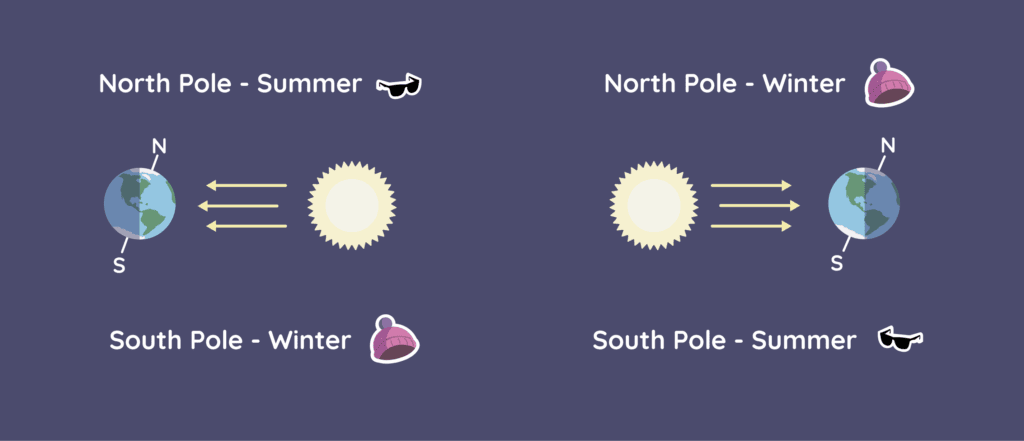
“I do think some perspectives change in different hemispheres, for example, the seasons are very different.”
This observation brings the discussion back to fundamentals. The tropical zodiac anchors itself to equinoxes and solstices, yet the seasonal experience associated with those points reverses south of the equator.The astronomical structure remains constant. The lived experience of that structure does not. This distinction is essential. It establishes that astrology operates within a relationship between sky and place, rather than as an abstract system detached from environment.
Meg’s position does not propose a reversal of astrological meaning. It identifies a condition. Interpretative language developed within a northern seasonal framework, and when practitioners apply that framework elsewhere, its assumptions become visible. The issue is therefore not theoretical disagreement. The question concerns how symbolism is lived under different conditions of light, season, and orientation.

As Gemini Brett notes, the directional relationship between Earth and sky remains physically real. The hemispheres do not alter the mechanics of the cosmos. They change how those mechanics are experienced from the ground. Astronomically, Earth’s axial tilt produces opposite seasonal conditions between north and south, meaning the same solar positions correspond to different environmental realities depending on location.
This places the interpretative responsibility back on the practitioner. If astrology describes lived experience, then hemisphere cannot be treated as incidental. It becomes part of the framework through which the chart is understood.
Terminology
“Some people call it astrocartography, some call it astrogeography, and some call it locational astrology — but it all refers to the same thing.”
Meg’s formulation resolves the question at the level of practice. Terminology varies, yet the underlying principle remains consistent: astrology is always expressed through place. The task is not to standardise language across contexts, but to understand how context shapes interpretation. Hemisphere, in this sense, is not a category to be debated. It is a condition to be read.
“My birthday is usually peak Summer where everyone is celebrating and enjoying life after a big summer break — however since moving to Ireland my birthday falls in the middle of Winter and it feels more relevant for me to want to cocoon and rest as my new solar revolution unfolds.”

This is where the southern hemisphere issue becomes especially concrete. The question is no longer only whether the zodiac should be interpreted seasonally in one way or another. It is how a person lives the same solar cycle under different environmental conditions. Meg’s comparison between South Africa and Ireland shows that hemisphere can alter the felt context in which a solar return, a birthday, or a period of personal renewal is experienced. That does not invalidate the natal chart. It shows why astrocartography and relocation work demand interpretive sensitivity rather than generic formulae.
From South to North: Ireland and the Structural Shift
“Moving to Ireland, now sitting in the Northern Hemisphere, doesn’t move my chart very much. The major difference now is that my Moon is below the horizon here, and Saturn is off the DC.”

Meg Knox-Davies’s experience is especially instructive from an astrocartographic perspective. Her relocation to Ireland does not overturn the natal chart, nor does it produce a dramatic break with everything that came before. What does change is the structure through which the chart is experienced. The shift is specific. Saturn is no longer sitting on the Descendant in the same way, and the Moon now falls below the horizon. In other words, the change is angular, observable, and tied to the actual mechanics aquired from relocation.
“The major difference is that I moved off my Saturn DC line.”
South Africa had established a strong Saturnian baseline. Ireland provides the first sustained contrast. For Meg, it’s not to escape the natal chart. It is the removal of one dominant locational emphasis that had shaped much of her earlier life. That distinction matters. Astrocartography, in her case, does not suggest that a person becomes someone else by crossing a border. It shows how different locations alter the conditions under which the same natal promise is lived.
Changes in Ireland
“I think for me, the biggest change in living in Ireland is that I am not channeling Saturn or other planetary lines on my DC here, almost like it has been a reset and I do feel as though the time I have spent here I have been able to embody more of my authentic personality without the restrictions Saturn placed on me.”
Meg does not directly describe Ireland in simplistic terms of better or easier. She describes it as a reset. The word is exact. It suggests release, rebalancing, and a different mode of expression rather than a total transformation. Saturn had not disappeared from her chart, though its grip through place had changed. What Ireland offers, in her own account, is a clearer sense of authenticity once that constant Descendant pressure is no longer structuring daily experience in the same way.
“In my relocated chart my AC changes, and this lines up perfectly with the changes I see in my progressed chart which I see as now being here has helped me to evolve my personality and my emotions since living here.”
That further deepens the point. The move to Ireland is not only about one line dropping away. It is also about a broader realignment in how personality and emotional life are expressed over time. Meg’s reading here is characteristically disciplined. She does not isolate relocation from progressions or from the unfolding of the natal chart itself. Instead, she reads the new place in relation to the wider developmental picture. In astrocartography, place matters, though it must always be interpreted in relation to the chart and its timing.
Asteroids in Astrocartography
“Moving to Ireland brought me closer to my Juno MC line — I relocated here originally due to my husband being offered a job here, and he is currently on his North Node AC line.”
This introduces another structural layer to the relocation. Ireland is not only defined by what moved away, namely Saturn on the DC. It is also shaped by what became more prominent. Juno on the Midheaven introduces a different public and relational emphasis, while the fact that her husband is on his Node Ascendant line reinforces the idea that relocation is rarely a single-person abstraction. It unfolds inside relationships, timing, and shared life decisions. In that sense, Ireland becomes a structurally different place on the map and a different chapter in lived reality.
Astrocartographers often interpret a couple’s chart together to gain an in-depth interpretation. It has been observed that our spouse’s planetary lines can affect our lives, and our children’s lives as well.
Natal Primacy and Interpretive Discipline
“Astrocartography starts with interpreting and fully acknowledging the natal promise found within the natal chart.”
This principle sits at the heart of the method. However far a person may travel, and however striking a relocation contrast may become, the natal chart remains the foundation. This is what prevents astrocartography from collapsing into generic line interpretation. For Meg, the map is never the first thing to interpret. It is read in relation to the underlying structure of the chart itself.
“I take a lot of time considering the natal chart before even looking at the astrocartography map and relocated chart.”
The map does not override the chart, and the relocated chart does not replace it. Instead, location is approached as a modulation of natal potential. This is a more disciplined, rigorous position than the simplified online model in which a person is told to chase one supposedly fortunate line and avoid another. Meg’s process begins at the source.
Role of Relocated Chart
“The changes seen in the relocated chart are helpful to note and be aware of, but the natal chart always takes precedence in my mind.”
That hierarchy is essential because it explains why her own South Africa-to-Ireland story is so compelling. The move matters, though it matters because of what it reveals about the natal chart under different locational conditions. In Meg’s framework, relocation is not a magical correction. It is an altered context through which natal themes may become heavier, lighter, clearer, or more visible.
“Your birth chart is your birth chart no matter where you are in the world.”
One foundational principle of astrocartography is that geographic relocation does not alter the natal chart itself. It modifies the conditions under which that chart is expressed. The underlying structure remains constant, while location changes the way its themes are experienced and made visible. One of the favorite expressions of astrocartographer’s is “Whereever you go, there you are”.
“You need to understand your birth chart before you interpret the map.”
A line by itself is never enough. The planet on that line must be understood in context: by sign, house, aspect, rulership, and the role it already plays in the natal pattern. Without that, interpretation becomes decorative rather than diagnostic. In her work, the map is not a shortcut around the chart. It is a specialised extension of it.
Beyond Generic Line Interpretations
“Social media influencers will promote only moving to Venus/Jupiter/Moon lines and this is a major misconception that challenges only exist if you move to a Saturn/Pluto line. This is woefully incorrect and potentially harmful rhetoric.”
This statement identifies a structural distortion in how astrocartography appears in public discourse. Practitioners often treat lines as inherently positive or negative, independent of the natal chart. That reduction removes interpretive context and replaces analysis with preference. In Meg’s method, no line holds meaning without reference to the natal structure that gives it context.
“Even though Saturn DC has posed some major challenges to me personally, it is also the place where I have found the strongest and most committed partnerships.”
This is precisely why her own case is so useful. Saturn, in the online imagination, is often treated as a line of burden, delay, and hardship. Meg does not deny the difficulty. She does something more valuable. She restores complexity. In her account, Saturn describes pressure and commitment together. The line is challenging, though it is also formative. This reflects a more rigorous astrological position than the avoidance logic now circulating online.

In The Psychology of Astro*Carto*Graphy, Kenneth Irving notes that Saturn and Pluto often resist conscious integration and therefore tend to manifest as “shadowed.” The idea builds on Carl Jung’s observation that every planet in the horoscope seeks outward expression, whether the conscious ego accepts that expression or not. In astrocartography, a shadowed planet refers to a planetary function that remains active yet resisted, underdeveloped, or projected outward rather than consciously integrated.
This explains why difficult lines do not reduce to simple avoidance. A more demanding planetary line can expose disowned material, while the same process can develop authority, maturity, and personal power when engaged consciously.
A useful distinction: shadowed planets
“I also have many clients who have thrived on Pluto lines.”
Pluto, like Saturn, is often turned into shorthand for danger. Meg’s experience with clients resists that simplification. In practice, a Pluto line may describe intensity, confrontation, depth, empowerment, or a necessary transformation. The question is never whether the line has a fixed global meaning in isolation. The question is how that planet is functioning in the natal chart of the person living it.

Rob Couteau makes the same point from another angle: “The planetary principles are inherently neutral. What is not neutral is our attitude toward them.”
In other words, a planetary line does not arrive with a fixed moral label. What matters is the natal condition of the planet, the person’s relationship to that principle, and the degree to which the individual lives that energy consciously.
The Role of the Least-Aspected Planet in Astrocartography: Planetary Symbolism in Astrocartography and Transcendental Astrology, Dominantstar, 2005.
“Venus is not always good and Pluto is not always bad. Nothing in life is that straightforward.”
Here, Meg vehemently pushes against the fantasy version of astrocartography and returns to a more adult understanding of place. Rejecting binary classification at the planetary meaning level, no planetary line carries an inherent positive or negative value. Its expression is contingent on the natal condition of the planet and the manner in which that principle is lived. Interpretation therefore requires evaluation of context rather than reliance on generalised associations.
“If your chart isn’t showing it, that’s not the energy you’ll feel — you’ll feel the complete opposite.”
The problem with generic line interpretation is not only that it is simplistic. It is that it can be wrong in a way that misleads people about major life decisions. A planetary line must be read in relation to the natal condition of that planet and the wider structure of the chart. Without that, interpretation loses precision and can lead to misleading conclusions about lived experience.
Time, Duration, and the Reality of Relocation
“Relocating and moving to a new country is hard — it’s not something that clicks automatically!”
Meg Knox-Davies speaks about relocation with the authority of someone who has actually done it. Someone who has lived it. Her work draws directly on experience. She never reduces relocation to the moment of arrival or to the excitement of a promising line on a map. Instead, she approaches it as a process that unfolds through time, adjustment, uncertainty, and lived experience.
“You need to give it time before you can truly see the effects of the move.”
A location may show immediate activation, though long-term support is something else. Clearly, the first emotional impact of a place may be real, though it does not yet tell the whole story. Sustainable relocation requires duration and patience. It requires seeing what remains after the novelty, disruption, and adrenaline have settled.
Intense Planetary Energies
“There are instances though where transits to your natal chart, and location you travel to can immediately give you signs that something is activating! I have travelled to certain lines, during key transits and felt the influence almost immediately as the plane landed.”

Nuance – Meg does not altogether deny short-term activation. On the contrary, she affirms it. A place can register quickly, especially when travel coincides with major timing factors. However, she separates that phenomenon from the deeper question of whether a location is genuinely supportive for long-term residence. Temporary stimulation and durable fit are not the same thing. That distinction is of the utmost importance in interpreting or judging relocation results.
“If you are wanting to find a permanent relocation, you need to consider your ACG, as well as CCG and lifecycle transits, progressions etc to truly see how a place can offer you long term support.”
Meg’s model of relocation is cumulative and acts as a strong corrective to one-layer thinking. Astrocartography matters, though it is read alongside additional timing and locational factors. The result is a more serious picture of how place unfolds over time. That seriousness is one of the features that distinguishes her work throughout the interview.
Practice, Responsibility, and Lived Authority
“I think the benefit I give my clients is that I have been where they are, I have had to make decisions and move away from all I know and start again.”
Meg Knox-Davies’s authority becomes evident on this point. It does not rest only on study, though she has studied extensively. It rests on the combination of technical training and lived relocation experience. She has crossed countries, returned to difficult lines, moved off them again, and observed those processes over time. That gives her client work a level of realism that purely theoretical interpretation rarely reaches.
“I take my job of reading their chart, map and transits very seriously because I know that sometimes we only have one shot to get this right.”
Meg does not consider astrocartography as entertainment, nor as lifestyle branding. She considers it as a serious practice with consequences. There are ethics involved in practicing astrocartography and becoming a professional astrocartographer. Responsibly, she advises people on movement, emigration, work, partnership, and place. It is also why she is resistant to generic online rhetoric and oversimplications. They can have negative effects on innocent people and this is ethically wrong.
Best Practice
“I want them to know all the facts and information so that they can make the very best decision for them.”
She gives a person enough grounded information to understand what a place may ask of them, support in them, or reveal in them. This is where lived authority becomes visible as professional restraint. The reading is serious because the choice belongs to the client.
“I also like to remind my clients that they don’t always need to relocate to find what they are looking for.”
Instead of relocation evangelism, Meg gives discerning advice. Sometimes there is no choice and the place must change. Other times, a change in perspective is necessary. Often, astrocartographers advise their clients to stay where they are because their location is perfect. Just knowing that they are aligned with their AstroMap is enough to cause improvement.
About Meg Knox-Davies

Meg Knox-Davies is a professional astrocartographer and the voice behind The Expat Astrologer, where she writes and speaks about relocation, locational astrology, and the lived reality of place through personal experience and professional practice. Her work draws on formal study, client consultation, and years of direct engagement with astrocartography across different countries and environments.
She graduated in Astromapping through Kepler College and holds certification from Continuum. She describes astrocartography as a lifelong discipline that requires testing through lived experience as much as through formal teaching. Alongside client work, she presents astrocartography to wider audiences, and in 2026 she will give a talk on the asteroid goddesses in astrocartography through the Aquarian Severn Astrological Society.
Website: expatastrologer.com
Kepler College, AstroMapping Analysis of Amanda Knox
Editorial Closing
Meg Knox-Davies’s interview leaves a clear impression. Astrocartography, in her hands, is neither fantasy nor formula. It’s a lived discipline shaped by birthplace, movement, and timing. Those are the original conditions through which the chart is first experienced. Her trajectory from South Africa to Ireland, and from personal relocation to professional practice, gives the subject unusual depth. What emerges is a practitioner who reads place with seriousness because she has lived what it can do.
For a deeper exploration of how extreme latitudes can shape astrocartographic interpretation, see my interview Nynne Noel: Astrocartography at High Latitudes – Between Light and Latitude.


Comments +